Ethernet Cable Types: Cat5e, Cat6, Cat6a, Cat7 — What’s the Difference?
Understand the differences in speed, shielding, and distance — and which cable is right for your network.
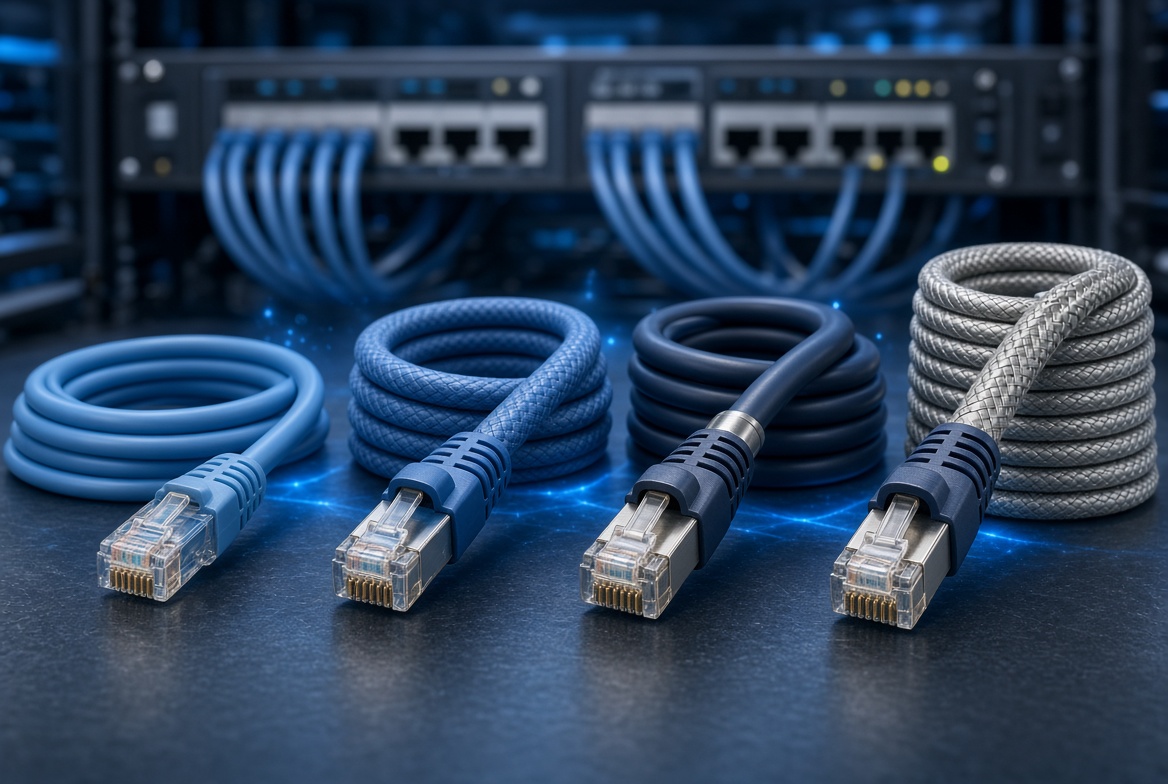
Ethernet Cable Comparison
Choosing the right Ethernet cable can be confusing. With so many categories (Cat5e, Cat6, Cat6a, Cat7, and Cat8), it's hard to know which one you actually need. This guide breaks down the differences in speed, shielding, and distance to help you choose the right cable for your network.
Cat5e (Category 5 Enhanced)
Cat5e (Category 5 Enhanced) is a popular wired network cable that supports data speeds up to 1 Gigabit per second (Gbps) and a 100 MHz bandwidth over distances up to 100 meters. It improves on older Cat5 cables by greatly reducing signal interference (crosstalk). Good for home use.
Cat6 (Category 6)
Cat6 (Category 6) isa standardized twisted-pair Ethernet cable supporting up to 250 MHz bandwidth. It delivers 1 Gbps speeds up to 100 meters and 10 Gbps speeds up to 55 meters, featuring stricter crosstalk specifications than Cat5e. Ideal for offices.
Cat6a (Category 6 Augmented)
Cat6a (Category 6 Augmented) isan advanced Ethernet cable standard that supports 10 gigabit speeds over a full 100-meter distance. It doubles the frequency bandwidth to 500 MHz and heavily reduces alien crosstalk compared to standard Cat6.
Cat7 (Category 7)
Cat7 (Category 7) isa high-end Ethernet cable standard ratified in 2002 to support 10 Gbps speeds over 100 meters. It features strict shielding with four individually shielded twisted pairs plus an overall shield to block signal noise, operating at a frequency of 600 MHz to 1,000 MHz.